

China’s Robot Density is Overstated
China's robot density looks very different when you count all the workers.

The International Federation of Robotics (IFR) releases annual data on industrial robotics deployment by country. IFR data is cited everywhere – basically any report on the scale of robotics deployment is based on numbers put out by IFR. One of the stats the IFR releases annually is robot density by country, which measures the number of industrial robots per 10,000 manufacturing workers. IFR’s density estimates suggest that not only is China deploying more robots than the US in absolute terms, they’re deploying more robots adjusted for the relative size of their industry: IFR estimated that China had a robot density of 470 robots per 10,000 manufacturing workers in 2023, while the US had only 295 robots per 10,000 manufacturing workers. This density estimate – and particularly the claim that China outstrips the US in robot density – has gotten picked up widely (see: 1, 2, 3, 4, 5, 6, 7, 8).
I think this estimate is likely wrong, and IFR overstates the density of China’s industrial robotics deployment by nearly a factor of three. The error comes from the fact that the IFR uses a very restrictive definition of China’s manufacturing base, which understates the number of manufacturing workers in China.
A general caveat: IFR reports are paywalled, and so I don’t have access to IFR’s methodology or complete dataset. All my estimates are based on their publicly available data. It’s possible that IFR offers a reasonable explanation for their manufacturing workforce estimates in their paywalled reports. If anyone with access to the full IFR report can confirm or correct the methodology described here, please let me know.
Density math
IFR defines robot density as the number of industrial robots per 10,000 manufacturing workers. While they don’t publicly release their estimates of manufacturing workers by country, we can back out the estimates they’re using based on their density numbers and their estimates of industrial robot stock by country.1
For most countries, the estimates of manufacturing workers that we can back out of their data seem reasonable. For example, IFR’s implied 2023 manufacturing base in the US is 12.9 million,2 which matches CES estimates of manufacturing employment in the US in 2023. Similarly, Japan’s implied 2024 manufacturing workforce of 10.1 million people is close to the OECD estimate of Japan’s 2024 manufacturing workforce of around 10.5 million people.3
Estimates of China’s robot density are where things get weird. IFR estimates that China had an operational stock of around 1.76 million robots in 2023, and a robot density of 470, implying a manufacturing workforce of around 37 million people. 4Indeed, IFR’s president described China as having “a huge manufacturing workforce of around 37 million people.”
The problem is that 37 million is probably much too low.
Counting workers in China
It appears that IFR is using an estimate from the Chinese Statistical Yearbook for the number of manufacturing employees in “Urban Non-Private Units,” which was 35,778,000 in 2023. In other words, the IFR is using the number of manufacturing employees in urban, non-private companies – excluding rural companies and private companies. This estimate in China’s yearbook is a relic of command economy-era conventions that didn’t account for private-sector companies, leading to systematic undercounting of private-sector manufacturers.
It’s no longer the case that most manufacturing workers in China are employed by state-owned companies. Indeed, according to the National Bureau of Statistics’ 2023 census, there were 105 million manufacturing employees in China when counting all types of employers, with an additional 18 million self-employed manufacturing workers.
Using the 105 million legal-entity figure (which includes private companies but excludes the self-employed), the actual robot density in China is 167 instead of 470 – about a third of the IFR estimate, and less than the robot density in the US.
Conclusion
The takeaway here should not be that China is lagging on robotics deployment. The per-capita numbers are probably lower than in the US, but the Chinese manufacturing sector is sufficiently larger than the US that China is still outpacing all countries in absolute number of robots installed annually.
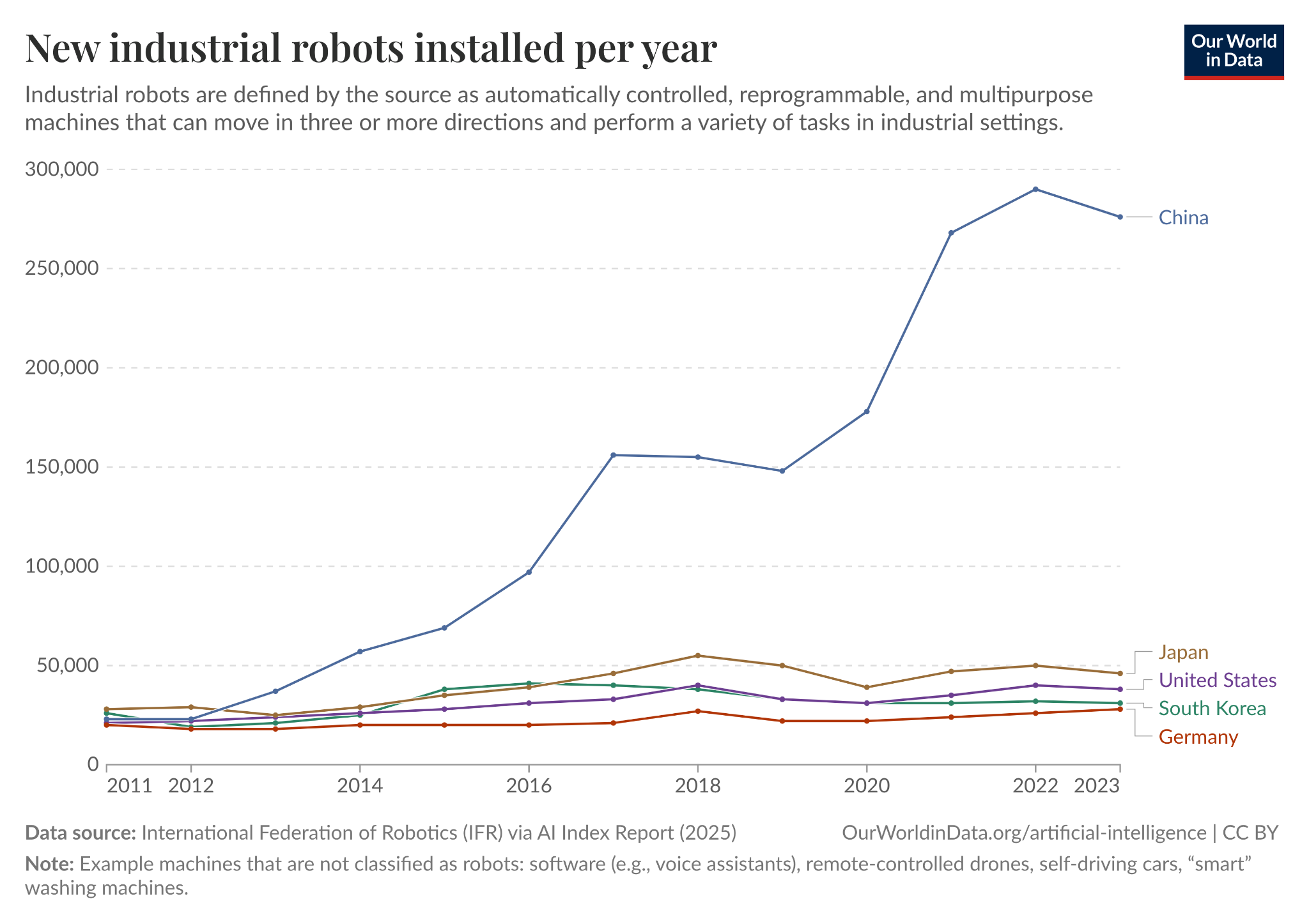
The takeaway should also not be that all IFR data is bad. I have no reason to think that the numerator of the density estimates (the estimate of total operational stock) is inaccurate.
But reports should stop citing IFR’s density estimates. If you’re going to compare robot density by country, calculate density yourself.
IFR-estimated manufacturing workers = industrial robot stock/density * 10,000.